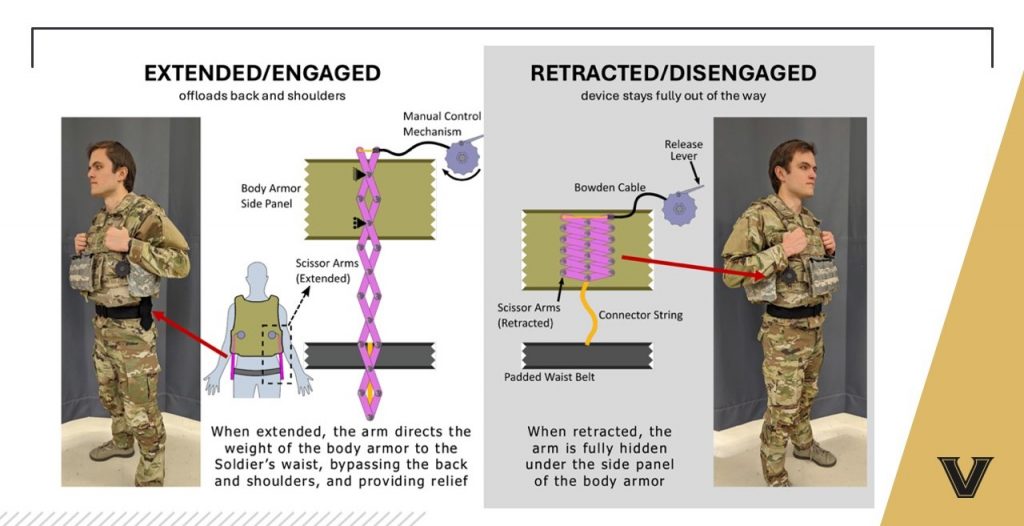
Vanderbilt researchers have developed a lightweight wearable device that shifts body armor weight off the shoulders and back of soldiers, helping reduce pain and injury risk.
A new study, “Wearable weight distribution devices for reducing injury risk: How varying amounts of body armor offloading affect biomechanics and comfort,” was recently published in the journal Applied Ergonomics—introducing this new technology and demonstrating initial evidence of efficacy.
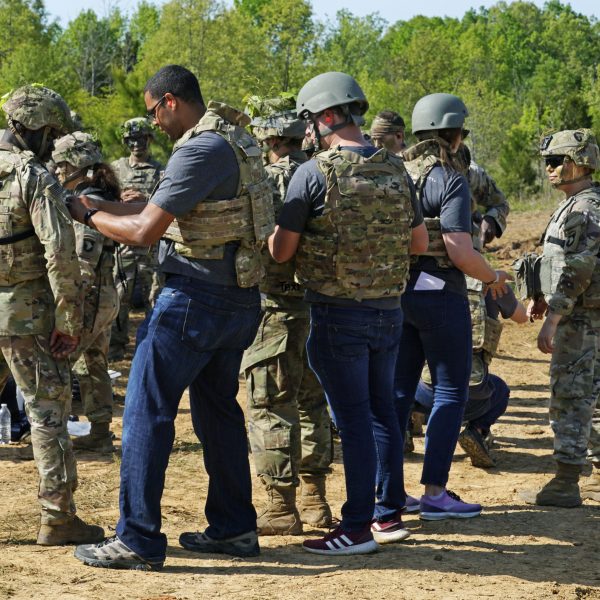
The research study was led by Paul Slaughter, a recent Vanderbilt Ph.D. graduate, and Karl Zelik, associate professor of mechanical engineering. Slaughter and Zelik, in partnership with Vanderbilt senior research engineer Chad Ice, also filed a patent on this wearable weight distribution device.
“We see opportunities for this device to help reduce musculoskeletal injuries and to accelerate recovery from back injuries in far-forward environments, which could help soldiers to remain effective,” Zelik said. “We’re eager to connect with military personnel and programs that could benefit from this capability, and we welcome opportunities for collaborative, translational development to further refine and test this device.”
This is not the first time Zelik’s lab has applied its biomechanics and wearable technology expertise to support service members. From 2021-2022, Zelik’s lab partnered closely with soldiers of the 101st Airborne Division. Together, with funding from the Army’s Pathfinder program, they developed an exosuit (a wearable lift-assist capability) to reduce musculoskeletal injuries and enhance Solider endurance during physically-demanding field operations related to sustainment and manual material handling. This exosuit technology was later commercialized into the Apex 2 exosuit by Vanderbilt spin-off company HeroWear. These exosuits now support thousands of civilian workers who bend and lift for a living, as well as service members in the U.S. and friendly foreign militaries.
Where that exosuit assisted with bending and lifting, this new weight distribution device provides relief from heavy body armor weight during upright standing, walking, and sitting. The new device works by redirecting some, or all, of the weight of body armor from the shoulders and back to the hips. In trials with U.S. military veterans, Zelik and his team tested offloading up to 90% of armor weight and found significant relief and improved comfort during standing and walking, and no negative impact on posture or muscle activity. This work was supported by a Vanderbilt University Scaling Success Grant.
“I am excited by the potential of this technology to help military service members offload their shoulders and back, while also still allowing them to fully perform their jobs,” Slaughter said.
Much of the innovation and intellectual property underlying this device has to do with design features, such as the retractable load-bearing elements, that enable it to be practical and easy to use in the field. The current prototype weighs only 2 lbs, provides adjustable back relief without motors or batteries, includes quick disengage and release features for emergencies, and allows soldiers to retain their full agility and freedom of movement. High usability was the result of a user-centric design process and working closely with soldiers and Army subject matter experts.
Back overuse injuries are one of the most common in the U.S. Army, affecting nearly 1 in 5 active duty soldiers each year. Prolonged armor wear is linked to a fourfold increase in low back pain, an issue also seen with police who wear body armor.
Zelik, who was recently honored by Vanderbilt as a Master Innovator for his contributions to translating research into commercial applications, is optimistic about the potential for technology translation and societal impact.