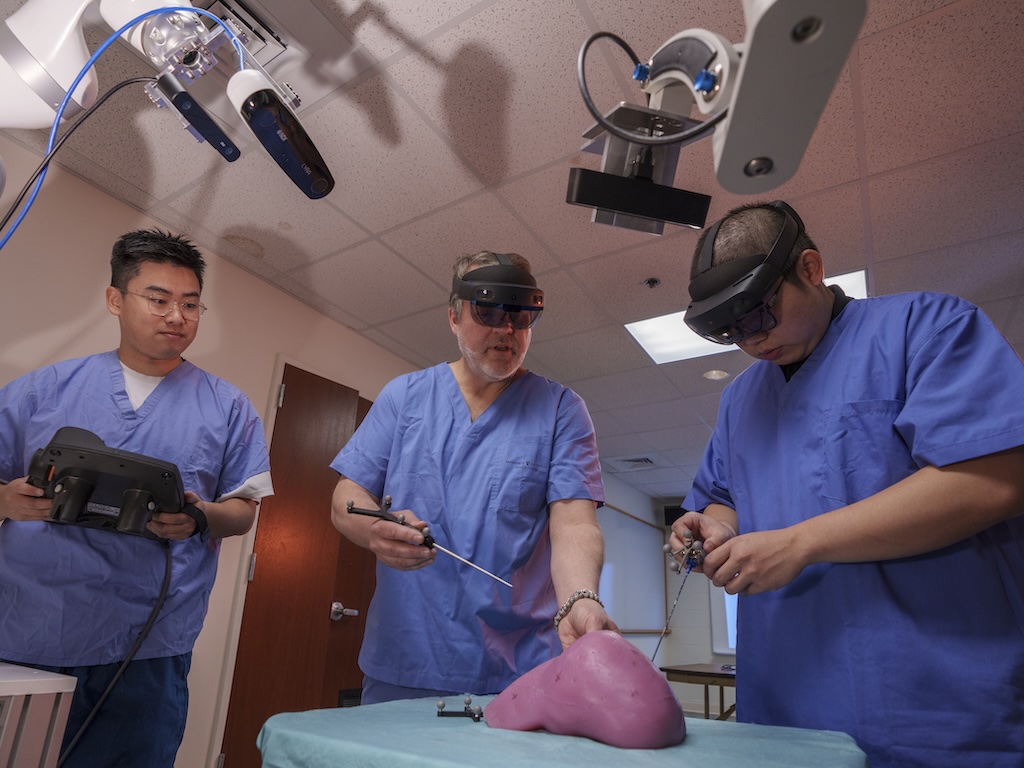
Vanderbilt University has developed a new, integrated MD/M.Eng. pathway in Surgery and Intervention, a one-year, industry-focused master’s track designed to equip future clinicians with advanced training in medical device engineering and medical AI.
The program, offered through the School of Engineering, in collaboration with the Vanderbilt Institute for Surgery and Engineering (VISE) and the School of Medicine, builds on the university’s leadership in translational design for image-guided therapies, surgical robotics, medical devices, AI, and data-driven intervention.
“This program is purpose-built for the modern clinician,” said program director Michael Miga, the Harvey Branscomb Professor, Chair of Biomedical Engineering, and Director of VISE. “By integrating rigorous engineering with real clinical context, medical students learn to frame problems the way innovators do—then prototype and validate solutions that are safe, effective, and deployable. From intelligent robotics and procedural guidance to AI-enabled decision support, we’re preparing physician-inventors to transform how care is delivered in the operating room and across multiple interventional environments.”
The Master of Engineering in Surgery and Intervention emphasizes technical engineering skills development and hands-on, problem-driven design. Students explore the full arc of innovation, from discovering needs in live clinical environments through concept generation, prototyping and validation. The curriculum—optimized for medical students—bridges core engineering disciplines into medicine, spanning across areas including:
- Medical AI and machine learning
- Medical devices, instrumentation, and surgical robotics
- Computational modeling, simulation, and digital twins
- Interventional imaging, treatment delivery, and treatment assessment
- Advanced therapeutic and diagnostic modalities
Focused graduate study in engineering establishes deep skillsets that are needed for physicians to lead the development of devices, algorithms, and integrated systems to pioneer new technology-enabled approaches to procedures that improve safety, precision, and outcomes in surgery and intervention.
“With growing interest in multiple advanced degrees, particularly among medical students seeking to expand beyond the traditional MD, the one-year Visionary Track within the ESI program offers a strategic path forward for students interested in physician-inventorship or medical technology development,” said program co-director Jon Heiselman, research assistant professor in biomedical engineering. “Clinicians and advanced-degree holders can transfer up to six credit hours into the program to accelerate their development in engineering, innovation, and clinically impactful design.”
Under the mentorship of Vanderbilt faculty across the School of Engineering and the Vanderbilt University Medical Center, students participate in immersive experiences that connect engineering R&D to procedural realities in clinical practice, such as imaging and sensing during intervention, robotic assistance, and procedural guidance personalized to each individual patient. In partnership with a Vanderbilt research laboratory, capstone projects challenge each student to design, build, and test solutions with a clear path to clinical utility, drawing on Vanderbilt’s tightly integrated ecosystem for surgery and engineering innovation.
Graduates of the MD/M.Eng. pathway are positioned for careers in medical technology and clinical innovation roles, whether advancing interventional capabilities as a physician-inventor investigator, directly supporting new technologies through startups and industry partnerships, or steering the translation of the most impactful, cutting-edge technologies into clinical practice. Aligned with Vanderbilt’s goal to improve health through excellence in discovery and innovation, the combined degree strengthens physician-engineer collaboration and expands the toolkit that clinicians bring to complex care.