Three engineering faculty join four other faculty recipients of Innovation Catalyst Fund awards for the October 2025 cycle. These awards empower faculty across disciplines to transform promising research concepts into tangible solutions that address critical societal needs through strategic pre-seed funding.
The newly selected research projects span innovative biomedical, medical, and AI technologies aimed at addressing critical healthcare challenges through advanced diagnostic tools, pathogen detection methods, and assistive systems.
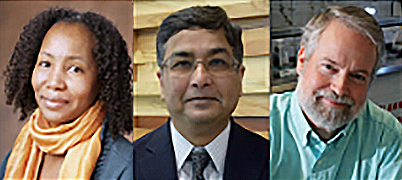
This cycle’s engineering recipients include:
- Audrey Bowden, professor of biomedical engineering: Advanced Prototype Development for an Ultra-low-cost Dermatoscope
- Frederick Haselton, professor of biomedical engineering: Exponentially scalable PCR for multiplex detection of pathogens in a single tube
- Nilanjan Sarkar, vice dean of school of engineering: Advancement of Neurodivergent-Aware VR Interview Simulator (NAVIS) for Job Interview Training
Other recipients are:
- Jonathan Heimlich, assistant professor of medicine: Development of a Commercial Assay for Clonal Hematopoiesis of Indeterminate Potential (CHIP)
- Brian Lima, associate professor of cardiac surgery: Development of a Conversational AI Interface and Real-Time Audio-Video Data Capture Framework for the AMPULSE Intelligent Perfusion System
- Brian Shirts, associate professor of pathology, microbiology, and immunology: Prototype development of empirical validation methods for genomic data
- Bryan Steitz, assistant professor of biomedical informatics: Testing and Clinical Validation of a Prototype Remote Sensing Device to Monitor Supplemental Oxygen Changes for Early Detection of Clinical Deterioration
“We are excited to be able to support our faculty at a critical moment in their innovation journey, when the curiosity and exploration of early-stage research gives way to the excitement of bringing a powerful new idea they know can work into the real world,” said Richard A. Schroeder Professor of Mechanical Engineering Bob Webster, senior associate provost for commercialization and technology transfer.
“The success of these projects will produce new lifesaving medical devices and therapeutics, and even new tools for workforce development. Each can beneficially transform an aspect of our world, and we eagerly anticipate the results our innovators will produce, in each area,” said Webster, who is also professor of electrical engineering, otolaryngology, neurological surgery, urologic surgery and of medicine.