
Engineering executive Peter Nabhan was looking for a way to help students find real-world technology experience through opportunities he didn’t have when he was in college. So, when he was approached about being a mentor in a program at Vanderbilt that helps students commercialize deep-tech prototypes that address societal needs, he couldn’t say no.
Nabhan, vice president of Nashville-based Engineering Consulting Services, was among about 10 other industry mentors who joined Vanderbilt faculty and staff for an event on Jan. 20 promoting one of the newest programs offered by the Wond’ry, called IMPACT (Innovation, Market-driven Productization, and Commercialization of deep Technologies).
The program initially launched in the fall semester of 2025 and has since grown to approximately 60 students. Open to Vanderbilt undergraduate students across all majors and disciplines, IMPACT offers a hands-on learning experience that allows students to design, prototype, and validate inventions across four key impact areas:
- Healthcare for all humans
- Ensure a sustainable planet
- Innovation beyond Earth
- National security and defense
“What I really like about the IMPACT program is the emphasis on the keynote speakers, combined with expertise from different areas of the school,” said Zachary Meryn, a first-year student majoring in mechanical engineering and mathematics. “When you have that kind of combination, that’s how we create real change.”
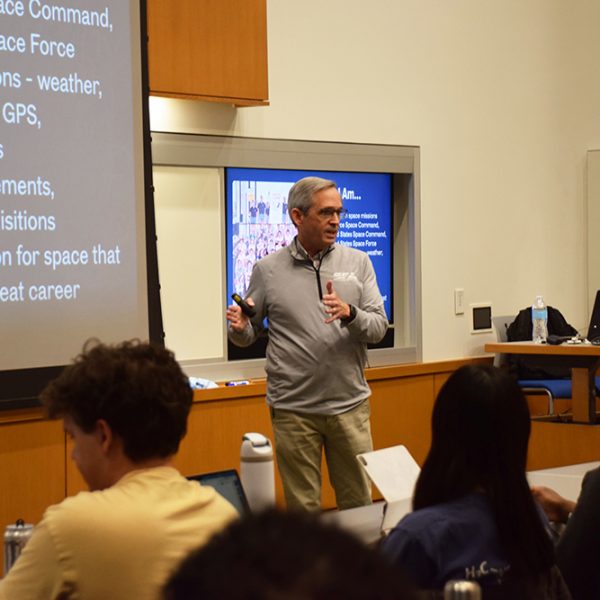
In the program, students engage in seminars, classes, and skill-building workshops through the Wond’ry, the university’s Center for Innovation and Design. The program unfolds through a multi-year sequence designed to take students from idea to market:
- IMPACT begins with the uncover phase, where students are introduced to the foundations of human-centered design and challenged to uncover unmet needs in deep-tech contexts. Guided by faculty, staff, and industry mentors, they develop core mindsets and skills through need-finding, stakeholder analysis, and real-world problem framing.
- In their second year, students advance from problem clarity to solution exploration. Students run design-build-test cycles, reduce technical risk, and develop basic technology strategy. They assess feasibility, manufacturability, safety, and data requirements (DfX), while aligning early regulatory and ethical constraints. By the end of the Invent phase, each team delivers a minimum viable prototype (or equivalent proof-of-concept).
- The third year marks the Propel phase, where students focus on business acumen and market readiness. Teams validate demand, pressure-test value propositions, and develop go-to-market and pricing models. By the end of Propel, each team compiles a venture dossier, market validation, unit economics, IP/regulatory plan, pilot commitments and a refined investor-grade pitch deck.
- A signature capstone of the IMPACT program is the Innovation Summit, where students present their inventions to industry leaders and Vanderbilt’s broader community, receiving feedback and forging connections that position their ideas for real-world implementation.
Speaking at the Jan. 20 IMPACT launch event, Krish Roy, the Bruce and Bridgitt Evans Dean of Engineering and University Distinguished Professor, said it’s great that the university has researchers “innovating, inventing and starting companies,” but he also wants to see students do it.
“You have great ideas,” Roy told the students. “We need to give you the infrastructure and space to be able to create new ideas, create new things, build them, productize them, test them, and launch. That’s the vision of IMPACT.”
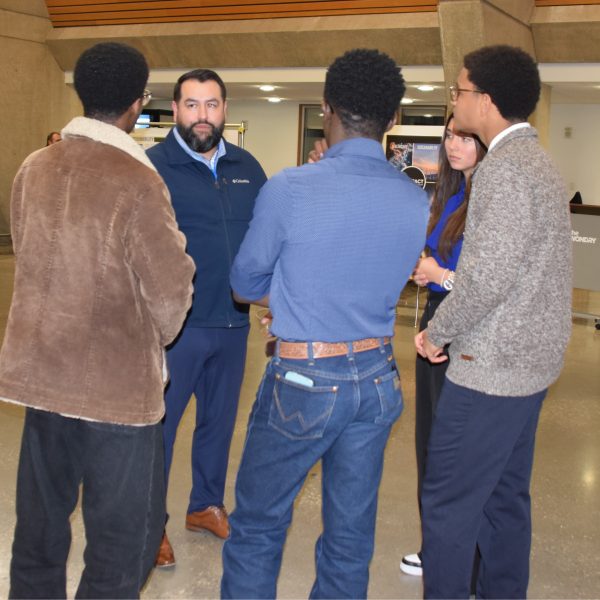
IMPACT program manager Cecilio Ponce said each week students hear from different keynote speakers, who are often affiliated with companies and organizations outside of Vanderbilt. He said the program’s speakers and mentors provide a valuable perspective for student participants.
“IMPACT at the Wond’ry is radical collaboration in action: an ecosystem where engineers, clinicians, designers, data scientists, founders, mentors and alumni work with students to move deep tech from uncovered need to invented solution to market reality,” Ponce said.
One recent speaker was Damon Feltman, Brigadier General, USAF (Ret.) and CEO of the Space Force Association (SFA). He is also a mentor in Space-Edge, a multi-institutional pre-accelerator educational program focused on the space economy. Feltman said he enjoys sharing his experiences with students.
“My government career (before SFA) has put me in a position to identify funding sources, use case scenarios to produce a stronger story, and help craft a stronger pitch,” Feltman said. “Having friends in venture capital is helpful, too.”
Nabhan said collectively all participants in the IMPACT program act as a bridge, helping students turn what they learn into real life experiences that will make an impact.
“I look forward to helping more students do that,” he said.
To participate in the IMPACT program or learn more about it, contact Cecilio Ponce at: cecilio.ponce@vanderbilt.edu.